
Every campaign image, product video and social cut passes through the same chain of work: someone plans it, someone makes it, someone approves it, it gets adapted for each market and channel, it goes live, and it either performs or it doesn’t. That chain is the content supply chain. Most brands run one without having designed it.
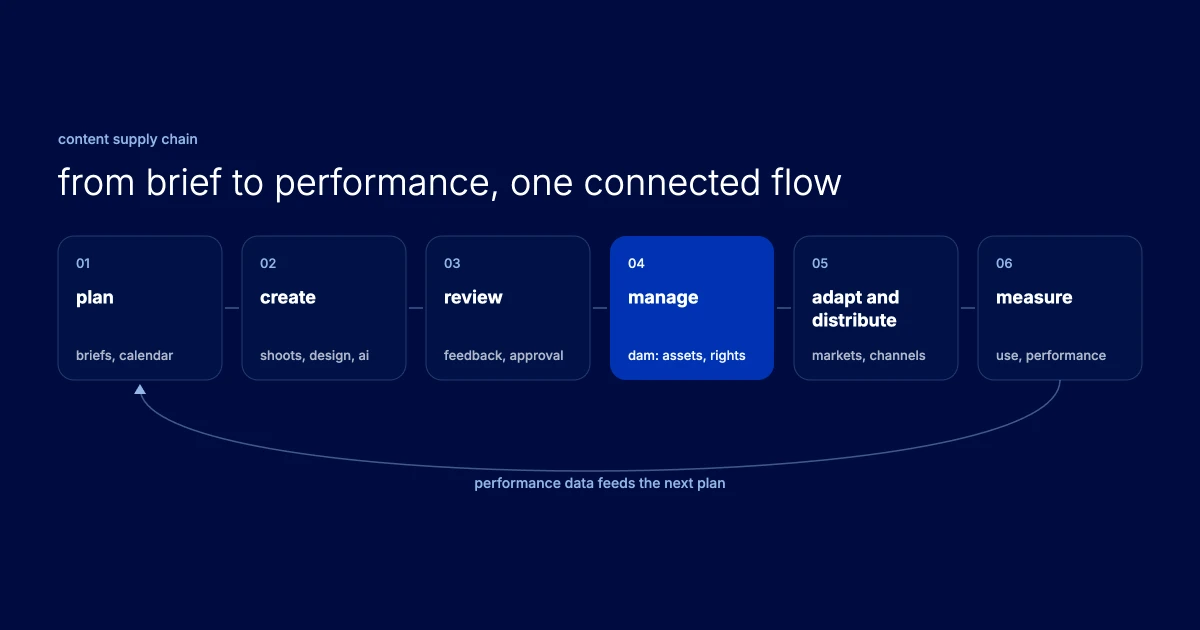
The six stages of a content supply chain
| Stage | What happens | Typical systems | Where it breaks |
|---|---|---|---|
| Plan | Briefs, campaign calendar, budget | Work management, briefing tools | Briefs that don’t say where content will run |
| Create | Shoots, design, copy, generative AI | Creative tools, agencies, AI models | Reshoots of products that were already photographed |
| Review | Feedback, legal and brand approval | Proofing and review tools | Approvals in email, with no record of who signed off |
| Manage | Store, tag, version, rights | DAM | Final files left on drives and in chat threads |
| Adapt and distribute | Resize, localize, publish to channels | DAM, CMS, PIM, social and ad platforms | Copies pushed out by hand and never updated |
| Measure | Usage, performance, cost per asset | Analytics, content intelligence | No link between an asset and its results |
Why it's called a supply chain
Content supply chain vs content operations vs DAM
| Scope | Question it answers | |
|---|---|---|
| Content supply chain | The whole flow, from brief to performance data, across teams and tools | How does content get from idea to result, and where is it slow or wasteful? |
| Content operations | The people, processes and governance that run the chain | Who does what, with which rules? |
| Digital asset management | The system that stores, governs and distributes the approved assets | Where is the right version, and can we use it here? |
| Creative operations | The production part: requests, resourcing, review | How do we make content on time and on budget? |
Where content supply chains break
How to improve your content supply chain
AI and agents in the content supply chain
Where Tenovos fits
Tenovos is the DAM and content intelligence layer of the content supply chain. It holds approved assets with their rights and metadata, connects to the tools around it through Tenovos Connect, and shows how each asset is used and performs, so the measure stage feeds the next plan.
Frequently Asked Questions
What is a content supply chain?
A content supply chain is the end-to-end process and set of systems used to plan, create, review, manage, adapt, distribute and measure content. It covers every hand-off from the first brief to performance data.
What are the stages of a content supply chain?
Most models use six stages: plan, create, review, manage, adapt and distribute, and measure. Measurement feeds back into planning, so the chain works as a loop.
What is the difference between a content supply chain and content operations?
The content supply chain is the flow of content from idea to result. Content operations are the people, processes and governance that run that flow.
What role does a DAM play in the content supply chain?
A DAM is the source of truth for approved assets. It stores final files with their metadata, versions and usage rights, and distributes them to every channel, so later stages never work from copies.
How do you measure a content supply chain?
Track time from brief to publish, cost per asset, reuse rate, the share of assets that are never used, and how each asset performs in the channels where it runs.
How does AI change the content supply chain?
Generative AI speeds up creation and multiplies variants, which puts more pressure on review, rights and tracking. AI agents can automate parts of that work when the DAM gives them reliable rights, approval and market data.