
Every campaign image, product video and social cut passes through the same chain of work: someone plans it, someone makes it, someone approves it, it gets adapted for each market and channel, it goes live, and it either performs or it doesn’t. That chain is the content supply chain. Most brands run one without having designed it.
Quick answer: A content supply chain is the end-to-end process and set of systems a company uses to plan, create, review, manage, adapt, distribute and measure content. Like a physical supply chain, its quality depends on the hand-offs between stages: when briefs, assets, approvals and performance data move cleanly, teams produce more with less rework.
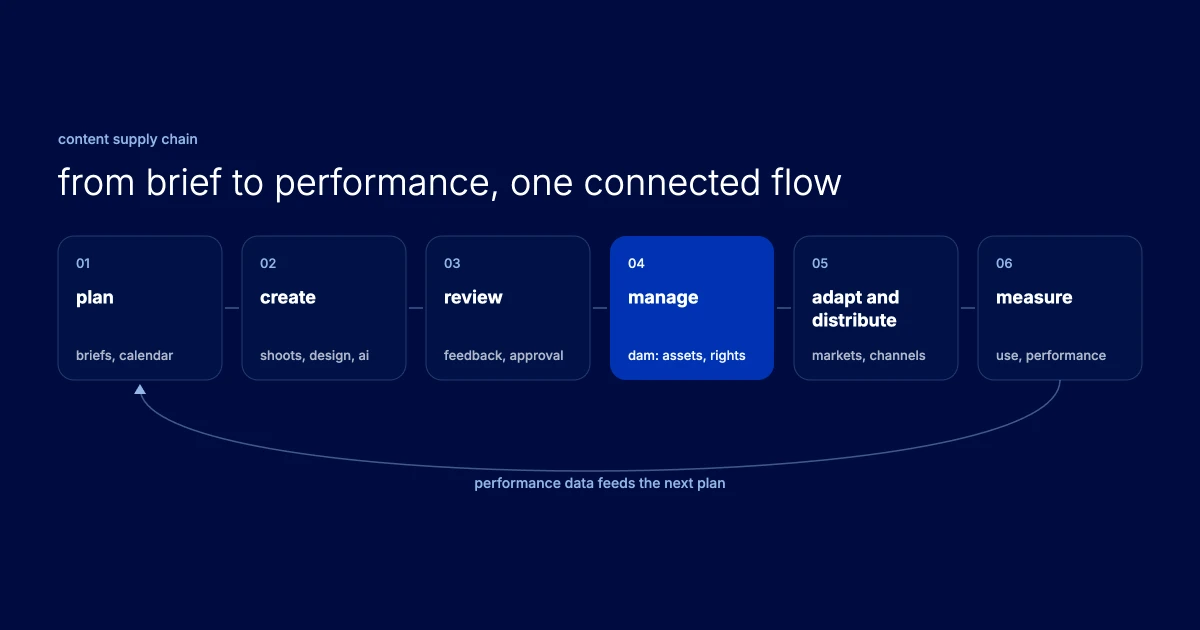
Content supply chain diagram: six stages, plan, create, review, manage, adapt and distribute, measure, with performance data feeding the next plan
The six stages of a content supply chain. The DAM holds the approved version every later stage uses, and performance data feeds the next plan.

The six stages of a content supply chain

Six stages cover most brand content. Each one has its own tools, and most problems sit in the hand-off between two of them.
Stage What happens Typical systems Where it breaks
Plan Briefs, campaign calendar, budget Work management, briefing tools Briefs that don’t say where content will run
Create Shoots, design, copy, generative AI Creative tools, agencies, AI models Reshoots of products that were already photographed
Review Feedback, legal and brand approval Proofing and review tools Approvals in email, with no record of who signed off
Manage Store, tag, version, rights DAM Final files left on drives and in chat threads
Adapt and distribute Resize, localize, publish to channels DAM, CMS, PIM, social and ad platforms Copies pushed out by hand and never updated
Measure Usage, performance, cost per asset Analytics, content intelligence No link between an asset and its results

Why it's called a supply chain

The term borrows from manufacturing on purpose. A physical supply chain moves raw materials through production to the customer; a content supply chain moves ideas through production to an audience. Both are judged on the same things: speed, cost, quality and waste.
The difference is that content is cheap to copy and hard to track. A product leaves the warehouse once. An image can be downloaded, edited and republished hundreds of times, often outside any system. That is why a content supply chain needs a single source of approved assets and data on how each one is used.
plancreatereviewmanageadapt and distributemeasure
Measurement feeds the next plan. The DAM sits in the middle, holding the approved version every later stage uses.

Content supply chain vs content operations vs DAM

These terms overlap, and vendors use them loosely. In practice:
Scope Question it answers
Content supply chain The whole flow, from brief to performance data, across teams and tools How does content get from idea to result, and where is it slow or wasteful?
Content operations The people, processes and governance that run the chain Who does what, with which rules?
Digital asset management The system that stores, governs and distributes the approved assets Where is the right version, and can we use it here?
Creative operations The production part: requests, resourcing, review How do we make content on time and on budget?

Where content supply chains break

Assets live in too many places
Final files sit in drives, chat threads and agency folders. People recreate what they cannot find. A content inventory usually shows more duplicates than expected.
Approvals are invisible
Feedback in email leaves no record. When a claim or license is questioned, nobody can show what was approved, by whom and when. Review and proofing tools fix the trail.
Adaptation is manual
Every market and channel needs its own size, language and format. Done by hand, localization becomes the slowest stage and the one with the most errors.
Nobody measures the output
Production costs are known; the return on each asset is not. Without usage and performance data, teams cannot tell which content to make more of.

How to improve your content supply chain

Fixing a content supply chain is mostly about connecting what exists, not buying a new tool for every stage.
1

Map the current chain
Follow three recent assets from brief to channel. Note every tool, hand-off and wait. The slowest step is rarely where people expect.
2

Make the DAM the source of truth
Final, approved assets live in one place with their metadata, versions and usage rights. Every channel pulls from there instead of from copies.
3

Connect the systems around it
Link the DAM to work management, creative tools, the PIM and the CMS, so briefs, product data and approved files move without re-uploading. See how a bi-directional sync works.
4

Automate the repetitive work
Renditions, tagging, routing and expiry checks are rules, not judgment calls. Automate them with workflows first; they are the easiest wins.
5

Measure use and performance per asset
Track where each asset runs and how it performs. Content performance analytics turn the last stage into input for the next plan.
6

Review it every quarter
Volumes, channels and teams change. Check the map again and remove the steps that no longer earn their place.

AI and agents in the content supply chain

Generative AI makes the create stage faster, which moves the bottleneck elsewhere: more variants need review, rights checks, storage and tracking. AI agents can take on parts of that work, but only inside a chain with clear rules.
More output, same review capacity
If AI multiplies the number of variants, review and approval must scale too, or the chain simply jams one stage later.
Agents need governed sources
An agent that picks an image for a market must be able to check rights, approval status and region. Those are DAM fields, not guesses.
Provenance matters more
When people and models both create content, records such as Content Credentials show how an asset was made and changed.
Measurement closes the loop
Performance data tells agents and people which content works, so the next round of production starts from evidence.

Where Tenovos fits

Tenovos is the DAM and content intelligence layer of the content supply chain. It holds approved assets with their rights and metadata, connects to the tools around it through Tenovos Connect, and shows how each asset is used and performs, so the measure stage feeds the next plan.

Book a demo

Frequently Asked Questions

What is a content supply chain?

A content supply chain is the end-to-end process and set of systems used to plan, create, review, manage, adapt, distribute and measure content. It covers every hand-off from the first brief to performance data.

What are the stages of a content supply chain?

Most models use six stages: plan, create, review, manage, adapt and distribute, and measure. Measurement feeds back into planning, so the chain works as a loop.

What is the difference between a content supply chain and content operations?

The content supply chain is the flow of content from idea to result. Content operations are the people, processes and governance that run that flow.

What role does a DAM play in the content supply chain?

A DAM is the source of truth for approved assets. It stores final files with their metadata, versions and usage rights, and distributes them to every channel, so later stages never work from copies.

How do you measure a content supply chain?

Track time from brief to publish, cost per asset, reuse rate, the share of assets that are never used, and how each asset performs in the channels where it runs.

How does AI change the content supply chain?

Generative AI speeds up creation and multiplies variants, which puts more pressure on review, rights and tracking. AI agents can automate parts of that work when the DAM gives them reliable rights, approval and market data.